
What Should My First AI Offer Be, and How Much Should I Charge?
Your first offer is the thing you can already do: something you have built, or a job you have done, for one kind of buyer who already pays to fix that problem. For the price, work out what the result is worth to the buyer in money, then charge a fraction of that number instead of an hourly rate.
The two questions arrive together because most people stall on both. This post answers them in order: what to sell, how to draw its edges, how to set the price, and how to say the number out loud without flinching.
Why You Shouldn't Charge by the Hour
I spent 14 years as a contract art director and motion designer, paid for my time. Getting faster at the work never once got me paid more for it, because an hourly rate rewards you for being slow.
Claude Code makes the problem sharper. If a build that took a week by hand now takes an afternoon, an hourly price shrinks to almost nothing while the result for the buyer is exactly the same. The buyer is paying for the result, so the price starts from the result.
Step 1: Pick What You Sell
Three questions stall most builders: what do I build, who buys it, and what do I charge. Take the first two today.
Match your background, not your ambition. People from operations and admin sell workflow automations. People from content sell content systems. People from sales sell lead systems. The best first offer is the one where you already speak the buyer's language, and an easy offer beats an impressive one while you have zero customers.
Don't invent a new category. A new category means you also have to convince the buyer that the problem is worth paying to fix, and that takes months you don't have. Pick a kind of work where money already changes hands.
The Real Builds Board, a page on the Claude Code Club site, lists those kinds of work in one table. Each row names a build, who buys it, and the price range reported for it. Its own note says every number is reported by someone else's business or a pricing guide, and none is guaranteed.
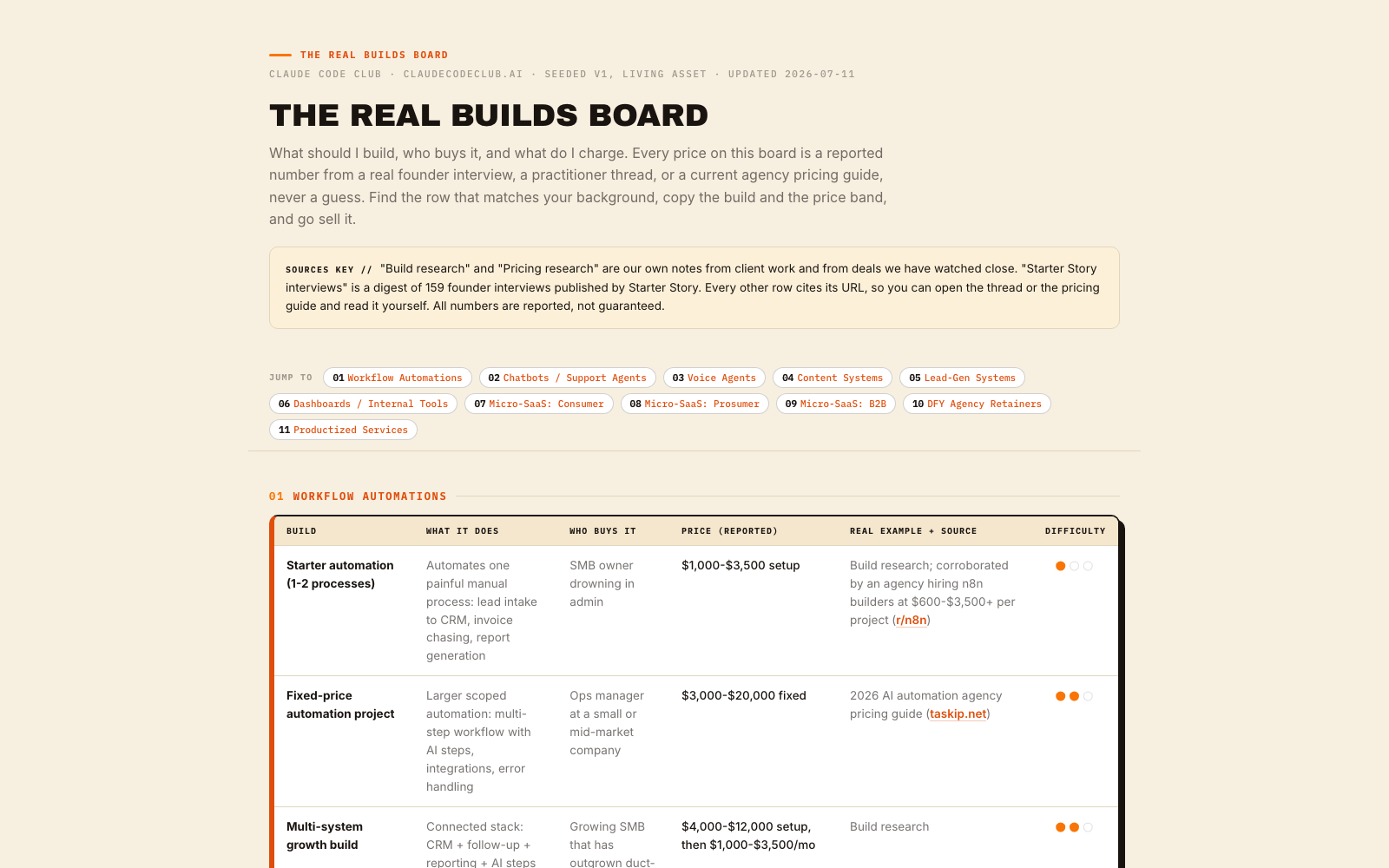
A few of the easier rows, as the board reports them:
These are what other people report charging, not what you will earn.
Easier rows from the Real Builds Board (prices are reported by third parties, not guaranteed)
| Build | Who buys it | Reported price |
|---|---|---|
| Starter automation (1 or 2 processes) | A small business owner drowning in admin | $1,000 to $3,500 setup |
| Website support chatbot | A business with a busy support inbox | $2,000 to $5,000 setup plus $99 to $500 a month |
| Short-form clip package | Creators, coaches, personal brands | $500 a month for 10 to 12 videos |
| LinkedIn ghostwriting retainer | Founders and executives | $1,000 to $5,000 a month |
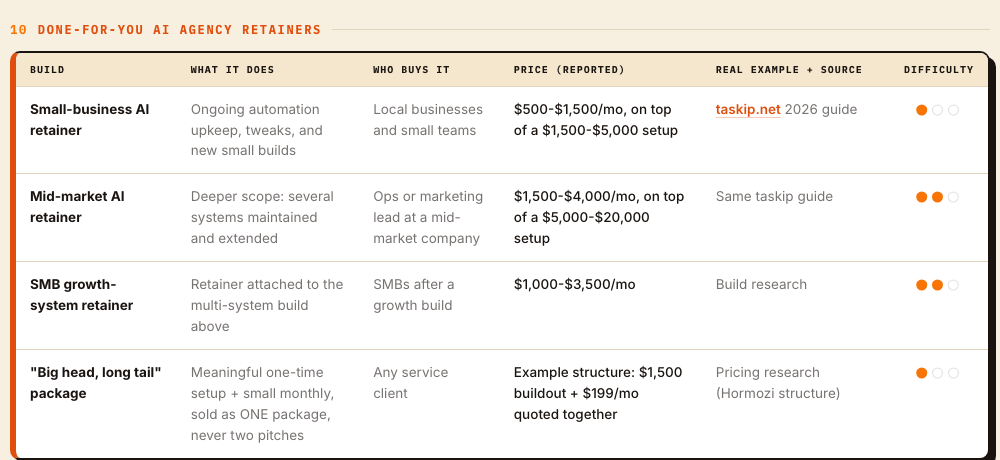
| Small-business AI retainer | Local businesses and small teams | $500 to $1,500 a month on top of a $1,500 to $5,000 setup |
If your row isn't obvious, paste this into Claude Code:
- I want to sell a build service. Here's what I've already built, even half-finished things: [list]. Here's what I did in past jobs: [roles]. Here's what people already ask me for help with: [what]. Give me three build types I could sell, ranked, each with the kind of buyer who pays for it. Then pick the one that's easiest for me to start with and tell me why.
Everyone has built something, even a spreadsheet that fixed their own week. Don't answer "nothing really" to the question about what you've built.
Step 2: Name the Result and Draw the Box
People buy the result, named in their own words. Someone tells me "I sell AI voice agents." Nobody wants an AI voice agent. They want to stop losing bookings to calls nobody picked up. Same build, and only one of those sentences gets bought.
Then draw the edges. Write down what's included and what isn't. Cap the variables: one platform, one revision round, five pages. Anything a client asks for outside the box becomes an add-on with its own price. The not-included list is the part everyone skips, and skipping it is how custom work walks back in through the side door.
The whole offer should fit in one breath: I build [result] for [buyer], done in [time]. Paste this into Claude Code to get there:
- Here's the work I want to sell: [describe it]. Here's who buys it: [buyer]. Turn it into a fixed offer: a name that says the outcome, a one-sentence promise in my buyer's words, what's included, how long delivery takes, and what is NOT included. Cap the variables so I can sell the same thing again without changing it.
Feed it real jobs you did last time. People go wrong by describing what they wish they sold instead of what they actually did.
Step 3: Set the Price From the Buyer's Side
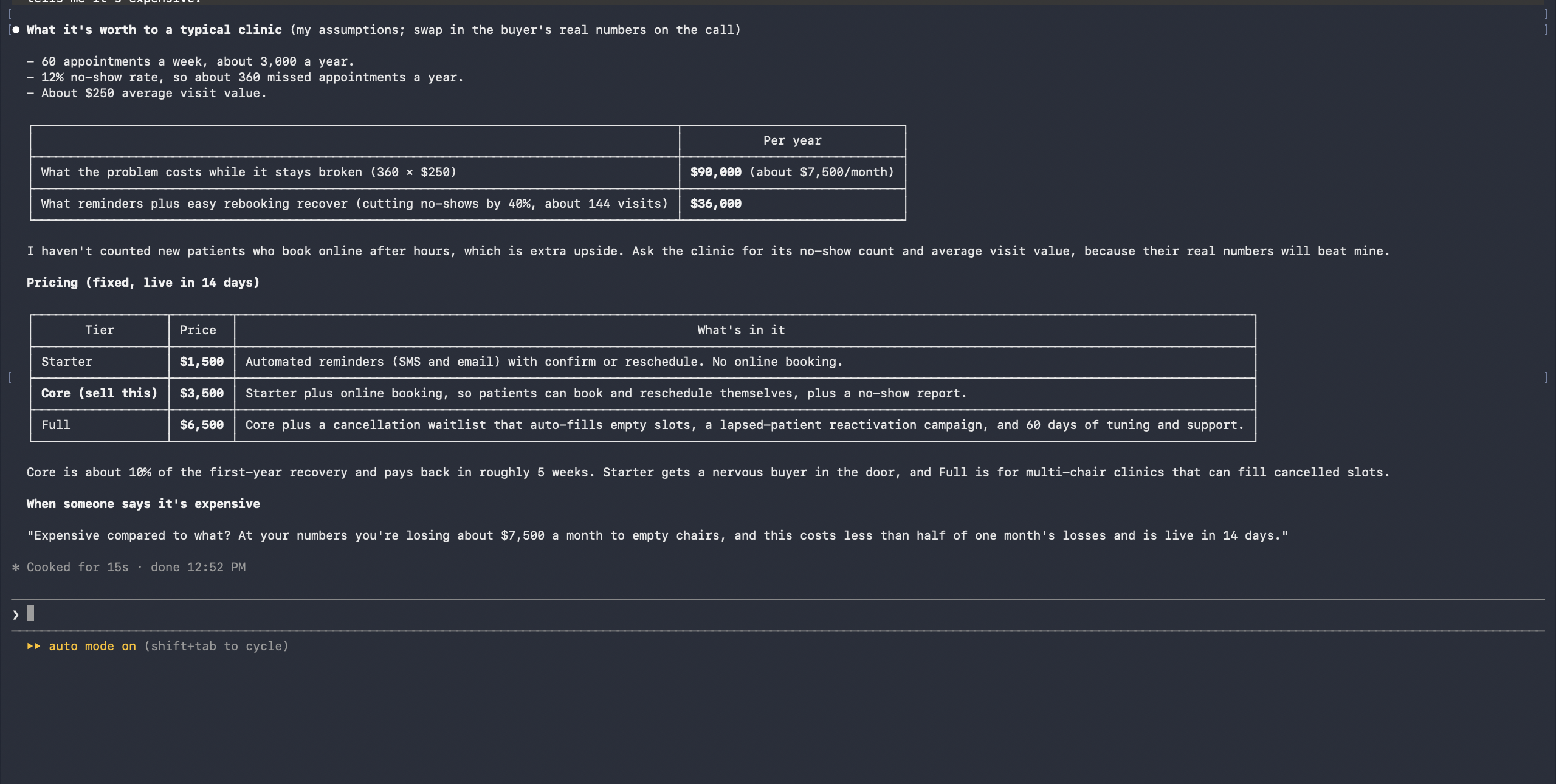
Work out what the result is worth to the buyer in money: what it earns them, what it saves them, or what the problem costs them every month it stays broken. Then charge a fraction of that number. About 10 to 30% of the outcome value is the range most buyers find rational, because at that fraction the return is obvious.
Pretend the result is worth $20,000 to the buyer over the first year. Then 10 to 30% of that is $2,000 to $6,000, and the buyer sees a price that is small next to the problem it removes. Those numbers are made up to show the arithmetic. Your buyer's real number comes from asking them what the problem costs today, not from a guess.
Three more rules for the number itself:
- Look at the reported range for your row before you pick a number. Cheap reads as risky, and a low number makes a buyer wonder what's missing.
- Offer three tiers, not one number. A buyer choosing between three options has stopped choosing whether to buy at all.
- Don't give the work away to get started. A free version hides the only honest feedback there is. A price is the one signal that can't lie to you.
Answering the value question with what the work costs you to make is the most common mistake. The question wants the buyer's number, not yours. Paste this into Claude Code with your offer from Step 2:
- Here's my offer and who it's for: [paste it]. Work out what the result is worth to the buyer in money: what it earns them, what it saves them, or what the problem costs them while it stays broken. Then give me a price at a fraction of that value, plus a cheaper tier and a dearer tier. Finish with the sentence I say when someone tells me it's expensive.
Step 4: Say the Number, Add a Guarantee, Then Stop Talking
Before you say your price, say a bigger number. The first number a buyer hears becomes the ruler they measure everything against. Name what they'd otherwise pay, such as a developer for a month, an agency retainer, or the person they'd have to hire. Then say yours, and your price starts to look like the cheap option.
Now say your price plainly and stop talking. Count eight seconds. Most people talk themselves into a discount in that silence. Holding the silence was one of the moves I had to practice before it felt normal.
When someone pushes, don't cut the number. Cutting your price teaches the buyer your number was made up, and tells them the work is worth less than you just said. Move the terms instead: split it into payments, take part today and the rest on delivery, or strip out the most expensive piece and sell the smaller thing.
Before you touch the number or the terms, take the risk off the buyer with a guarantee. Nobody knows you yet, so the question under every price objection is what happens if they pay and it doesn't work. Three guarantees you can pick from:
- Fix anything that's wrong at no extra cost.
- Keep working for free until the thing you promised is working.
- Their money back if you don't deliver what you said.
Climb only as far as you could honor on your worst week, put a date or a number in the sentence ("if your automation isn't live in 14 days, you don't pay"), and say it the same way every time. If a buyer asks "can you do it cheaper," the answer is the guarantee and the terms, not a discount.
Step 5: Raise the Price as You Close Customers
Your first price was a guess, because you had no customers when you set it. Every customer you close changes that: you know what the work takes, you know what the result is worth to them, and you have somebody who would say so out loud.
The rule of thumb I teach is to raise the price about 20% every 5 customers. Keep going until buyers start pausing before they say yes. The pause is the target, because it means the price finally matches the value they can see. A fast yes every single time is information too: your number sits under what the result is worth, and you're covering the difference out of your own pocket.
Check one thing at every raise: your promise, your proof and your guarantee have to keep up with the new number. A price that outruns its proof stalls. Fix the proof and the price holds.
Common Problems
- The number sticks in your throat: that flinch is normal, because the number is new to your mouth. Say the whole line out loud three times: I help [who] get [result]. It's called [name], and it's [price].
- Your offer is a list of features: more features don't add desire, they add confusion. One clear outcome beats ten bullet points.
- A buyer says "it's too expensive": ask what they're comparing it to, then work out what the problem costs them each month it stays. If it's real cash flow, move the terms, not the number.
- Clients keep asking for more: anything outside your included list is an add-on with its own price. That's what the not-included list is for.
- You don't know which tier to lead with: lead with the middle one. Cheap tiers exist so the middle tier looks reasonable.
Where to Go Next
If you've built something and aren't sure how to put it in front of buyers, read I built something with Claude Code. Now what, and how do I get customers?. If your offer is a website for a local business, Can Claude Code build a website I can sell to clients? walks through it. I teach the offer, pricing and first-sale steps in order inside Claude Code Club, which is $9/month.
Short, practical drops on skills, MCP, agents, prompts, and more. No spam, unsubscribe anytime.
Frequently asked questions
What is a good first AI offer for a beginner?
Something you have already built or done for someone, sold to one kind of buyer who already pays to fix that problem. Start with an easier build such as a starter automation, a website support chatbot or a content package, and name it after the result the buyer gets, not the tool you used.
Should I charge by the hour or by the project?
By the project, priced from the buyer's side. Work out what the result is worth to them in money, then charge a fraction of it. Hourly pricing rewards you for being slow, and Claude Code makes you faster, which would shrink your income for the same result.
How much should my first AI project cost?
Look at the reported range for your kind of build before you pick a number. The Real Builds Board lists a starter automation at $1,000 to $3,500 setup, for example, but those are reported numbers from other people's businesses and are not guaranteed, so check them against what the result is worth to your own buyer.
What if a client says my price is too high?
Don't cut the number. Ask what they're comparing it to, point to what the problem costs them each month it stays unsolved, and take the risk off them with a guarantee. If cash flow is the real issue, change the terms by splitting the payment or taking part now and the rest on delivery.
When should I raise my prices?
About 20% every 5 customers you close, and keep going until buyers start to pause before saying yes. Make sure your promise, proof and guarantee grow with the new number.
Last reviewed by Duncan Rogoff on November 9, 2026