
I Built Something With Claude Code. Now What, and How Do I Get Customers?
Stop building. Write down one offer for one kind of buyer, then put a small working version of it in front of ten people who have that problem, because customers come from conversations, not from a finished product.
A member on one of my calls put it this way: "I've got it to the version where it's demoable, but it's like, I have this thing now, what do I do now." Nothing about that is a building problem. Everything after the build is a different set of moves, and this post walks through them in order.
Why More Building Is the Wrong Next Step
Building feels like progress, and it is safe, because nobody can say no to a half-finished project. Putting it in front of a person is where the answer comes back.
I've been through the full loop myself. My co-founder David and I built Showplace, a product that turned a Zillow listing link into a 40-second cinematic real-estate video in about 5 minutes. We put it in front of customers and took on a few. Then we decided we weren't the right founders to scale it, and shut it down. I'm proud of the build. What told us whether to keep going was never the code. It was the customers.
The same shape shows up in the other direction, too. When I started posting on LinkedIn about the systems I was building, not pitching, just showing what I worked on that week, two clients came out of it, and both wanted the same thing: their LinkedIn content run for them. I never went looking for either one. People who watched me build something wanted something like it built for them.
Step 1: Write Your Offer as One Sentence
Nobody buys "an AI automation." They buy the problem going away. So the sentence names a buyer and a result, not a tool: I help [who] get [result].
- Weak: I build AI voice agents.
- Better: I help dental clinics stop losing bookings to calls nobody picked up.
- Weak: I make websites with Claude Code.
- Better: I help plumbers get more calls from their website.
The two Better lines are examples of the shape, not claims about results you can promise. Fill in the shape with what you actually built. If you built a booking tool for your own gym, your buyer is other gym owners. If you built a content planner for yourself, your buyer is people who run content the way you do.
One offer, one kind of buyer. A founder I spoke with on a call sells one thing to one kind of buyer, an AI system for law firms. He went hunting for a different offer. He didn't need one. He needed to keep telling law firms what he had built.
If you can't write the sentence yet, paste what you built into Claude Code and ask for help:
- Here's what I built: [describe it]. Here's what I did in past jobs: [roles]. Give me three kinds of buyer who would pay to have this problem gone, ranked, and write the sentence "I help [who] get [result]" for each. Then pick the one that's easiest for me to start with and tell me why.
Step 2: Talk to Three People Before You Pitch Anyone
Before you sell, you need the truth about the problem, and most conversations are fluff because people are polite. Three rules get you the truth. Talk about their life, not your product. Ask what already happened, not what they would do. Talk less than they do.
"Would you buy this?" gets you a nice lie. "Talk me through the last time that happened" gets you facts. Three kinds of answer are worthless: compliments, vague future talk, and feature requests. Write down what the person has already tried instead.
The strongest signal is a workaround. If someone has cobbled together a spreadsheet and two apps to survive the problem, they will pay to be rid of all of it.
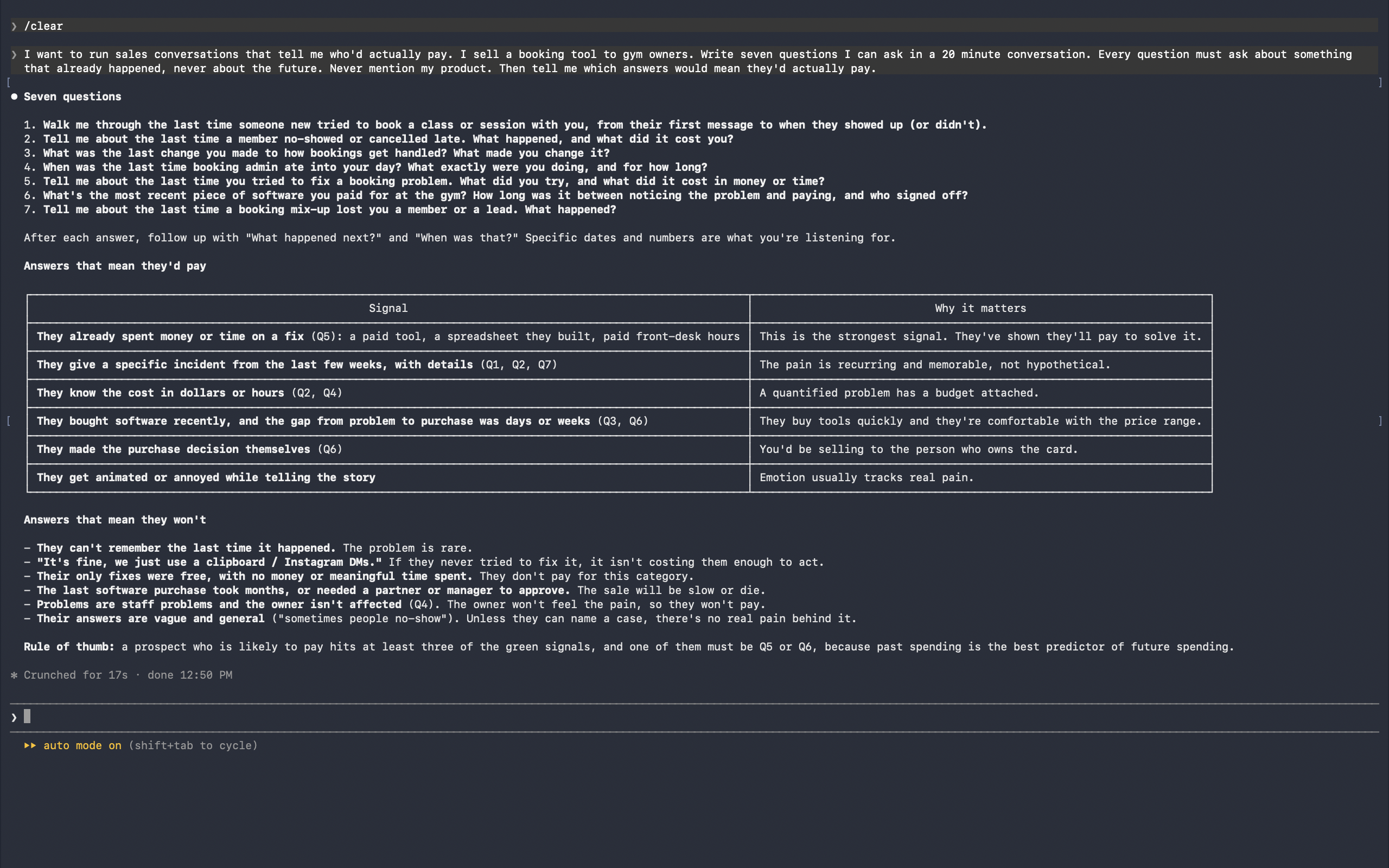
Close every conversation with the same question: "Is there anything else I should have asked?" Then run three of these this week. Who to talk to? Start with people you already know who fit your sentence from Step 1, or people one introduction away. Ten conversations tell you more about your offer than ten weeks of thinking about it.
Step 3: Send a Small Working Thing, Not a Pitch
A stranger gives you about 30 seconds. A pitch spends all 30 and then asks for more. So send something that already works: a small version built for their exact business with their own details inside it, or a 60 second screen recording of their real problem being fixed, with you talking over it.
The message stops being "I can help you" and becomes "I already built part of it for you." Nobody has to take your word for anything, which matters most when you have no proof yet.
- Cap the build at 90 minutes. If it takes longer, you picked too big a piece.
- Do one a week, not ten. Each one goes to someone who fits your Step 1 sentence.
- Put their name, their logo or their real numbers in it, so it's obviously made for them.
Paste this into Claude Code to get going:
- Here's a person I want to build something small for, and what I know about their business: [paste]. Ask me for any details you're missing. Then help me build them something useful in 90 minutes: a small tool with their own details in it. Then write the short message I send with it. No pitch language, just what I noticed and what I already built.
Step 4: Answer Every Reply the Same Day
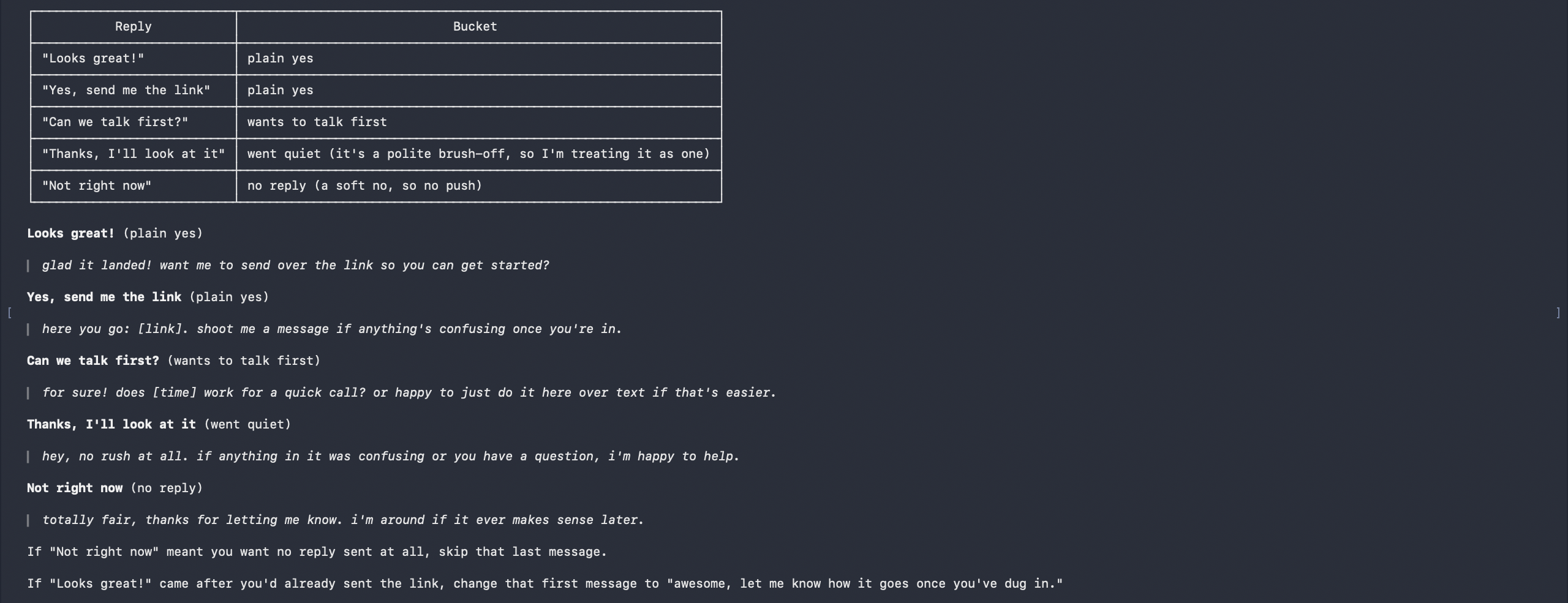
A thread that goes quiet after a warm reply is the most common way a customer disappears. You get a reply, you feel good, and nothing comes next. So sort your replies into four buckets and send something to each one today.
- A plain "yes": send your walkthrough link and your payment link. No call. A yes means stop selling.
- "Can we talk first?": a 15 minute demo of the one workflow that erases the pain they named. Say your price, then go quiet.
- Went quiet: one honest bump, not five. "Did you get a chance to look? Happy to show you on your own stuff, 15 minutes."
- No reply at all: write a follow-up date next to their name so nobody floats.
Step 5: Get Paid With a Link, Not a Checkout You Build
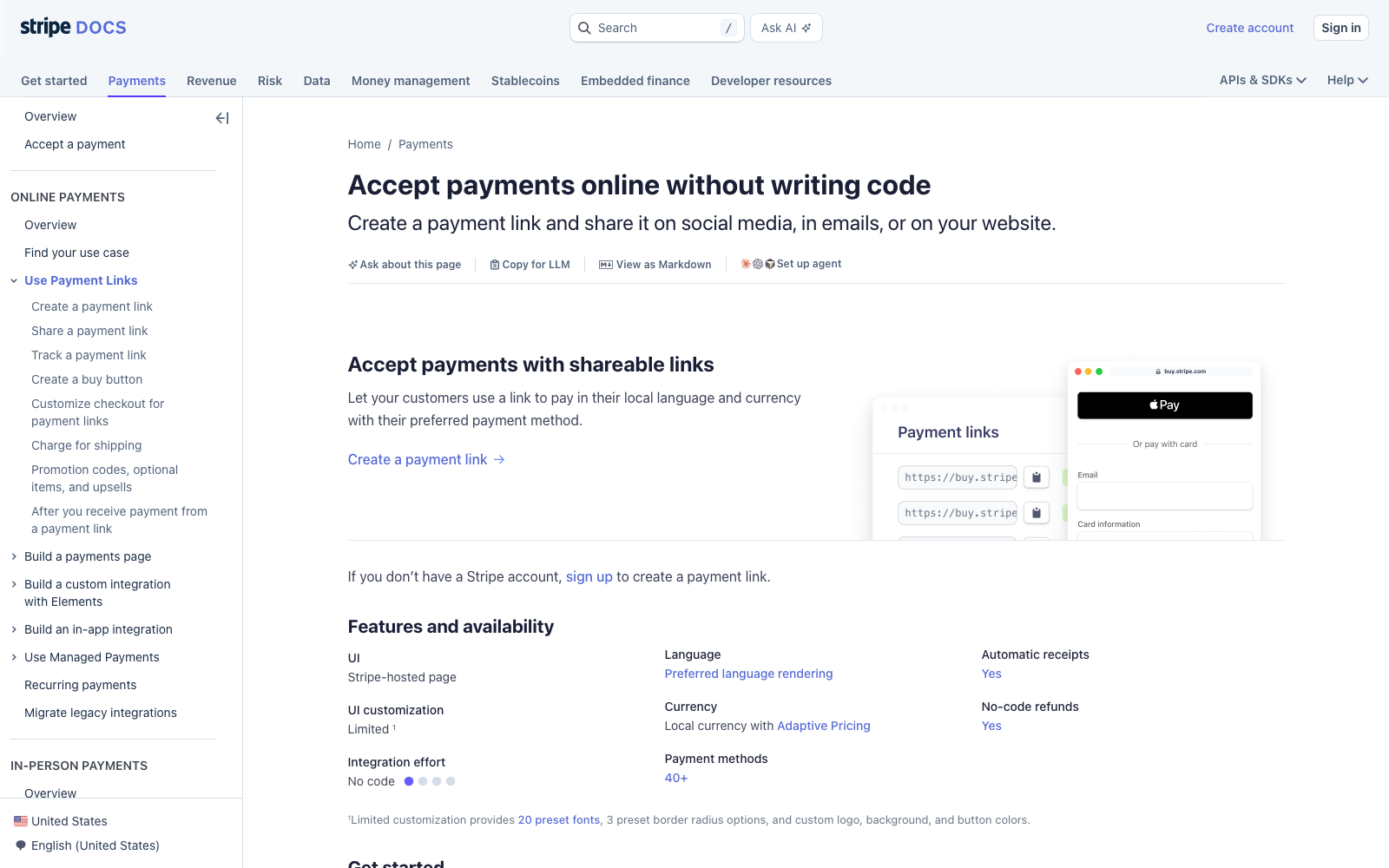
Don't build a payment system. Stripe, the company that handles online card payments, offers Payment Links: you create a link in your Stripe account and the customer pays on a page Stripe hosts. Stripe's docs list the setup effort as no code, with automatic receipts and refunds you can issue from the dashboard without code.
If you're selling a service rather than a product, say your price plainly and then stop talking. Count to eight in your head. Most people talk themselves into a discount in that silence. If someone pushes, change the terms and leave the number alone: split it into payments, or take part now and the rest on delivery. If you can't deliver within a week, take a deposit and a start date.
Step 6: Give Your First Customer a Win Inside 48 Hours
The scariest moment for a buyer is right after they pay. Message them the day the money lands: what happens now, when they'll first see value, and that you'll set it up yourself. Then find the smallest moment that proves the thing works, not the full result, just the first "oh, this actually works," and remove every step between paying and that moment.
Do the things that don't scale. Get on a video call and watch them use it. Fix whatever trips them up while you're watching. Roughly one in a thousand people who say they'd rather set it up themselves actually does it, and ten buyers is small enough to do by hand.
If something breaks, own it the same day and name a fix date. Going quiet is the only move you can't come back from.
Common Problems
- Nobody replies: you probably sent a pitch. Send the small working thing instead, and send it to people who match your Step 1 sentence, not to everyone.
- People say "looks great" and nothing happens: compliments cost them nothing. Ask the question from Step 2, "talk me through the last time that happened," and look for a workaround they already pay for in time or money.
- A friend wants it, and you feel weird charging: a member on one of my coaching calls described exactly this, "I'm not going to charge him because, you know... he's a friend." A price is the one signal that can't lie to you, and a free version hides the only honest feedback there is.
- You keep adding features before you send anything: build the smallest piece you could show in one day, and leave the rest unbuilt until someone has paid.
- Sales feels uncomfortable: the discomfort tells you that you've reached the part that pays. Closing is a skill, a short set of moves you can learn, not a personality.
Where to Go Next
Once you can answer the question "who is this for and what does it get them," the next question is what to charge, so read What should my first AI offer be, and how much should I charge?. If your build is a website, Can Claude Code build a website I can sell to clients? covers that case start to finish. And if you'd like these steps laid out with me in order, Claude Code Club is $9/month.
Short, practical drops on skills, MCP, agents, prompts, and more. No spam, unsubscribe anytime.
Frequently asked questions
How do I get my first customer after building something with Claude Code?
Name one offer for one kind of buyer, talk to three people who have the problem, then send one of them a small working version built with their own details instead of a sales pitch. When someone says yes, send them a Stripe payment link and make sure they see a first result within 48 hours.
Should I finish building before I try to sell?
No. Build the smallest piece you could show in a day and take the conversation to that. A yes tells you what to finish and silence tells you what to change, so you don't need a finished product to get either answer.
How do I take payment without building a checkout?
Use Stripe Payment Links. Stripe's documentation describes them as a no-code way to accept payments: you create a link in your Stripe account, share it by email, text or social media, and the customer pays on a Stripe-hosted page. You'll need a Stripe account first.
What if I have no proof or past customers yet?
Hand over the result first. A small working thing built for their business, or a short screen recording of their real problem being fixed, means nobody has to take your word for anything. After your first customer, ask them for a sentence about what changed and use that as your proof.
Last reviewed by Duncan Rogoff on November 9, 2026